
Opportunities for Postdocs in Clusters of Excellence
In January 2026, 70 Clusters of Excellence (25 newly established and 45 renewed) began their current seven-year funding period (2026–2032). These Clusters play a central role in the national research landscape, bringing together cutting-edge research and strong institutional networks.
Furthermore, they create a wide range of opportunities for R2/R3 researchers and offer structured support for postdocs and group leaders. In discussions with postdocs, we realized that many are often unaware of the Clusters of Excellence and their specific support offers. To address this gap, we have created this overview page as a central resource in English that brings together key information on research focus areas, planned support offers, and the websites where job opportunities will be published.
Given the lack of a central platform for R2/R3 job offers in Germany, this overview serves as a practical workaround to increase transparency and visibility, especially for international researchers, and to help navigate this important part of the German research ecosystem.
How to use this list
Currently, we have received input from around 50 of the 70 Clusters of Excellence, and we expect further contributions soon. You can browse through the Cluster profiles, bookmark the job portals on Cluster websites, follow their social media channels, and track updates on upcoming calls and positions.
Particularly the newly established Clusters are still setting up their structures, communication channels, and support offers while renewed Clusters and already have established recruitment and support systems. This means that the level of detail and available information differs across Clusters.
How do the Clusters function?
A Cluster of Excellence is typically centered on a highly ambitious, interdisciplinary research topic and aims to be internationally competitive. Clusters can be managed by up to three universities and usually involve larger consortia that include non-university research institutions as partners, ensuring access to broad expertise and research infrastructure. Each Cluster has its own governance structures, including spokespersons, management positions, boards, and advisory committees.
We are very pleased that more than 80% of responding Clusters confirmed that they appoint a dedicated early-career coordinator to support postdocs / early-career researchers in their Cluster. Almost all Clusters also have or plan to have early-career/postdoc representatives who are often included in committees to ensure their perspectives are represented. Clusters provide, or plan to provide, comprehensive support programmes for postdocs and group leaders, including mentoring, career development, and networking opportunities.
What about postdoc positions?
Here’s the tricky part: each Cluster follows its own strategy, and the number of planned R2/R3 positions, recruitment procedures, and timelines vary considerably. Some Clusters run central recruitment rounds, some replied that positions were already filled before the start of the funding period. Other Clusters advertise individual positions on a rolling basis throughout the funding phase, and some positions will only become available in the coming years.
If you are actively looking for postdoc opportunities, we recommend that you save and regularly check the Cluster job portals or social media channels for advertised positions. We also recommend that you proactively contact principal investigators (PIs) whose research aligns with your profile to inquire about upcoming openings, explore collaboration opportunities, or discuss joint applications for third-party funding.
Please refrain from sending generic mass emails to coordinators or PIs. Especially at the postdoc level, researchers are expected to demonstrate clear research alignment, strategic interest, and project-based communication.
Read more
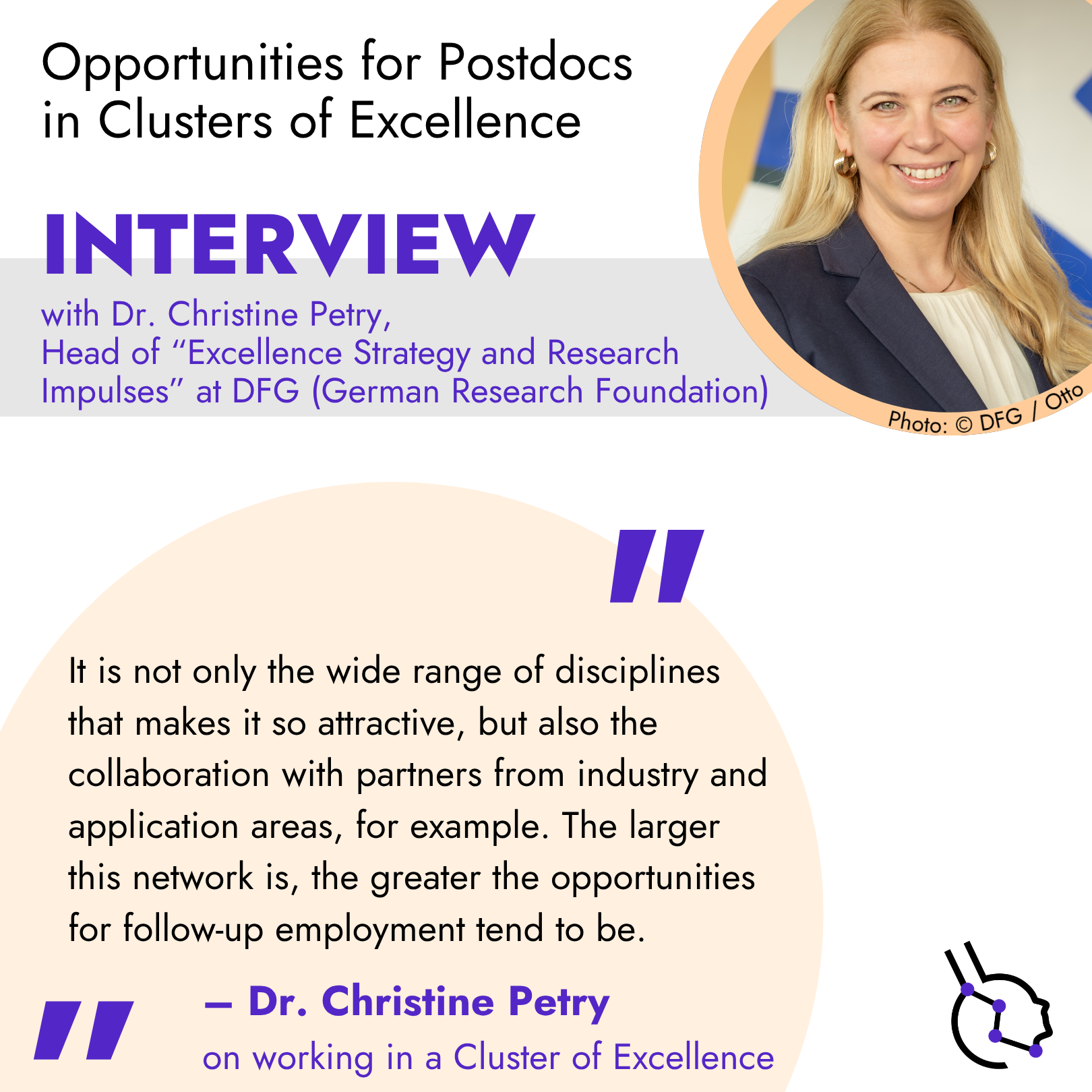
We had the pleasure of discussing in more detail the value of collaboration within a cluster from a postdoc’s perspective with Dr. Christine Petry, Head of “Excellence Strategy and Research Impulses” at the Deutsche Forschungsgemeinschaft (DFG, German Research Foundation). Read the full interview here.
Some further notes
A big thank you to Anh Vu Doan and Monique Hacker for their support in creating this overview.
The DFG also maintains a job listing site for positions within its funded projects. For more general information on the Clusters of Excellence, visit the website Exzellenzstrategie.de.