
Interview with Dr. Christine Petry, DFG
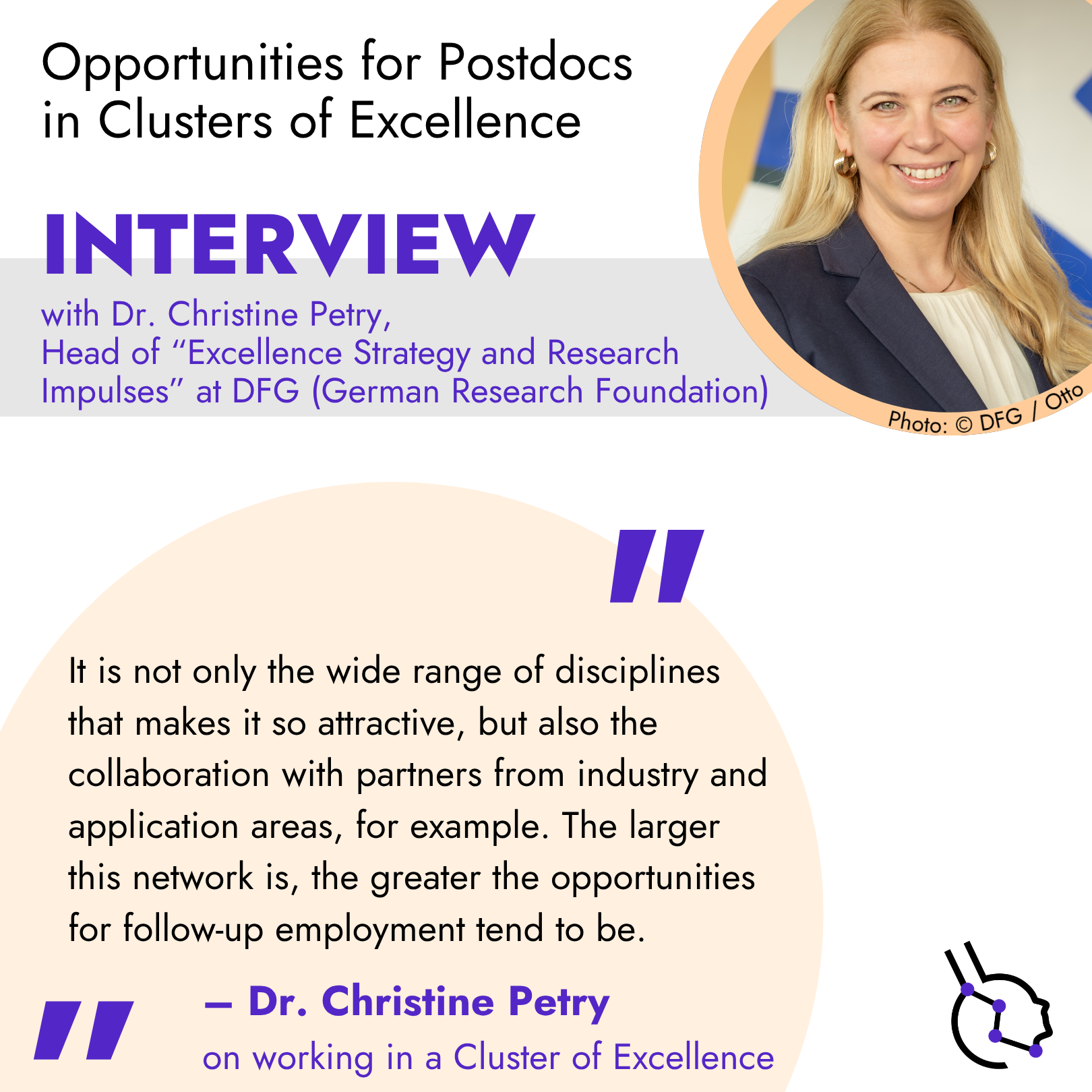
We recently published an overview of opportunities for postdocs in Clusters of Excellence. Following on from this, we had the pleasure of discussing in more detail the value of collaboration within a cluster from a postdoc’s perspective with Dr. Christine Petry, Head of “Excellence Strategy and Research Impulses” at the Deutsche Forschungsgemeinschaft (DFG, German Research Foundation). Read the full interview here.
GPN: Many researchers from abroad who come to Germany are not necessarily familiar with the DFG's Strategy of Excellence. Please start by telling us: what do you think makes working in a Cluster of Excellence particularly attractive?
Dr. Christine Petry: First of all, the clusters operate in a very international environment. This is demonstrated by the figures from our 2025 monitoring: people from more than 80 countries were employed in a cluster at that time, and the proportion of international postdocs is very high, even compared to other funding programmes. What is more, there is evidence of a steadily increasing proportion of female researchers and international staff in the clusters.
Clusters of Excellence often offer interdisciplinary research opportunities. Interdisciplinary research is naturally carried out within a network, so you are not alone in your approach. Often there are also dedicated junior research group positions that come with staff. These are very attractive positions.
During our monitoring, we also noticed that funding for Clusters of Excellence also leads to the continued development of structures at universities. Universities often create positions in the cluster's subject area following the funding, so it continues to be part of their profile. This can open up opportunities to make career planning more predictable.
GPN: Why is the postdoctoral phase particularly suitable for being part of a Cluster of Excellence?
Dr. Christine Petry: Beyond their own positions, cluster employees can benefit from support for different career stages. I think the opportunity to benefit from structured programmes as a postdoc is particularly good. For early postdocs, the focus is more on writing third-party funding applications, initial training in leadership and family-friendly measures. In the later postdoc phase, training for professorship applications and career coaching are added.
In addition, integration into the cluster's network is of course valuable: it is not only the wide range of disciplines that makes it so attractive, but also the collaboration with partners from industry and application areas, for example. The larger this network is, the greater the opportunities for follow-up employment tend to be.
GPN: How has the significance of support services for postdocs in the clusters developed over the funding periods?
Dr. Christine Petry: It is becoming apparent that greater attention is being paid to this career phase and that a distinction is now being made between early and advanced postdoctoral phases. As a result, greater efforts are being made to tailor the services on offer to the different phases. In addition, initial considerations are being made to tailor support services to individuals who do not wish to pursue a career in academia beyond their current position.
GPN: What measures for postdocs in the clusters do you consider particularly useful?
Dr. Christine Petry: I think all the measures are equally important. But depending on the needs of the individuals, their relevance may vary. For me, the key aspect of these measures is the fact that they raise awareness of the need to think about postdocs and their careers. For example, when during the proposal phase clusters reflect on what their postdocs need, this also triggers a shift in mindset at the leadership level: Do our postdocs truly have everything they need for their career development? Where do they still require support, or perhaps more freedom?
GPN: In your opinion, which measures for postdocs could be improved overall?
Dr. Christine Petry: There is already a strong support framework in place for spin-offs and knowledge transfer, but the potential in this area has not yet been fully realised. I also believe that support options for postdocs with specific needs will remain an issue, despite good individual measures, as they are often required to navigate the various offices and services. At the same time, it is above all crucial to ensure that postdocs have sufficient time for their own research and not to overwhelm them with too many support offerings.
GPN: In spring 2026, the DFG proposed a new funding instrument called ‘Nexus’ for networks of excellence at European level. What opportunities could this offer to postdocs if it were to be implemented?
Dr. Christine Petry: If it were implemented as a science-led and bottom-up instrument, as the DFG, HRK and WR envisage, it would certainly be highly attractive to postdocs. The already mentioned network possibilities of a Cluster of Excellence that exist on a national level with research institutions and application partners would then exist at European level. However, it is absolutely clear that Nexus must not cannibalise the other Early Career Researcher (ECR) tools, especially those of the ERC. Rather, the aim is to provide additional funding to further strengthen networks and cooperation.
GPN: Would you like to add anything else?
Dr. Christine Petry: Let me briefly summarise: What I find particularly exciting about the opportunities within the clusters is the clearly positive development in terms of internationalisation and the proportion of women. I would also like to emphasise a point that is not always immediately apparent, namely that the cluster network can also create attractive follow-up employment opportunities. In other words, if I move to such a university, opportunities in my field may arise beyond the position within the cluster itself. In short, I would highly recommend working in a cluster to my children!
Dr. Christine Petry is Head of “Excellence Strategy and Research Impulses” at the Deutsche Forschungsgemeinschaft (DFG, German Research Foundation), where she coordinates the Excellence Strategy and the Clusters of Excellence programme and is responsible for the “Research Impulses” funding initiative for universities of applied sciences. She has more than twenty years of experience in research funding and programme development at the DFG, including Collaborative Research Centres, Research Training Groups and the Excellence Initiative framework. She studied history, law and German studies in Mainz, Trier, Tours and Paris and holds a Ph.D. in Modern History.