Throwback: Career Planning in German Academia
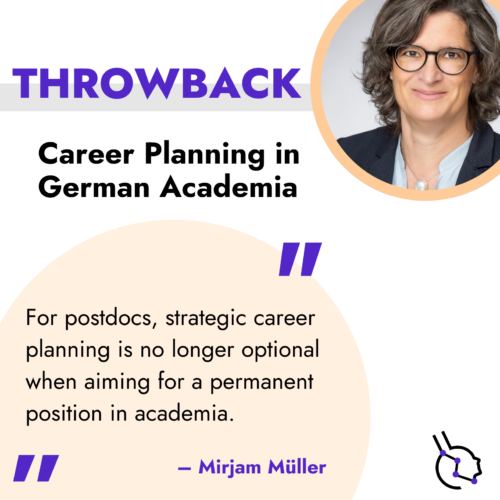
We were delighted to host Mirjam Müller, Head of Postdoc Affairs and Academic Career Coach from the University of Konstanz at our recent Understanding the system lunch talk. The session focused on career planning in German academia, with particular attention to the challenges faced by international researchers. What became very clear: for postdocs, strategic career planning is no longer optional when aiming for a permanent position in academia.
Mirjam Müller shared seven key steps that help researchers strengthen their sense of agency, recognize opportunities, and navigate uncertainty with greater clarity:
- Evaluate Your Achievements
Start by looking at what you have achieved so far in terms of your academic portfolio: publications, qualifications (e.g. habilitation or equivalent), external funding, teaching, management and more. When it comes to permanent positions, academic output and funding usually carry the greatest weight, whereas your research profile and mentors are important strategic levers. - Gather Feedback
Next, reflect on the feedback you have received within your scientific community and schedule structured career conversations with supervisors or mentors — early and on a recurring basis. - Expand Your Career Knowledge
Learn as much as possible about both formal and informal rules of German academia. This includes legal frameworks (such as the Wissenschaftszeitvertragsgesetz), key institutions, leading researchers, disciplinary norms, and relevant networks. Informal rules are often conveyed by mentors or more advanced peers. - Evaluate Skills, Values, and Goals
Honest self-assessment is essential. Reflect on your strengths, motivations and priorities, and use structured tools such as ResearchComp or Individual Development Plans to support this process.
-
- The European Competence Framework for Researchers Self-Assessment Tool
- Individual Development Planner:
On this page, we have listed further resources.
- Make a Decision
Remaining in academia should be an active decision, not a default. If you feel unsure, try creative decision-making approaches: an experimental setup, the inner team, or narrative exercises that help you imagine different futures. - Plan Strategically
Define clear priorities and next steps – and make time for them. Planning tools such as individual development plans or methods like backward planning can be helpful: start with where you want to be in five years and identify what needs to happen before then. For some, developing an alternative career plan alongside your academic one may relieve stress. - Leverage Available Resources
Mentoring programmes, career services, peer networks, coaching, seed funding and professional networks exist at the majority of German research institutions. Making use of them is not a weakness, but a strategic choice.
For those interested in diving deeper, Mirjam Müller’s recent books provide practical guidance on academic careers in Germany :
- In English: Mirjam Müller (2025). From PhD to Professorship: A Practical Guide to Academic Careers in Germany. Bielefeld: transcript.
- In German: Mirjam Müller (2025). Promotion - Postdoc - Professur. Karriereplanung in der Wissenschaft. 3., aktualisierte und erweiterte Auflage. Frankfurt/New York: Campus.
The German Postdoc Network has visualized career paths to foster an overview of different roles. As a first step, our website provides an overview of academic career paths here. Feel free to drop us a note with your feedback on the visuals here.
Thank you to everyone who joined the session and shared their questions.