WissZeitVG FAQ
On this page, we are outlining Frequently Asked Questions about the postdoc phase in Germany, and in particular, the "WissZeitVG". Please note that this document has been assembled by volunteer postdocs to help orient fellow postdocs with regard to relevant terms and parameters; do not take it as personal legal advice. We are not lawyers, and the law is up for interpretation. For your specific situation, please contact your Human Resources department (HR) and supervisor before taking action or making plans.
Definitions
What is the WissZeitVG, and why does it matter for postdocs?
The Wissenschaftszeitvertragsgesetz (WissZeitVG) is the federal law regulating fixed-term academic employment contracts in Germany. It sets maximum durations (6-9 years) for temporary contracts before and after acquiring a doctorate degree and aims to balance support for career development with limits on fixed-term employment. There is a general 2-year limitation on fixed-term contracts in German labor law, WissZeitVG represents an exception for researchers.It is possible to interpret the law as trying to limit the exploitation of postdocs by making it harder to keep stringing them along on time-fixed contracts, and instead incentivising employers to create permanent positions for workers they value. However, many stakeholders are finding that the current situation is falling short of that goal and/or is otherwise suboptimal.
You can read the current law text here.
What counts as a doctorate degree in Germany?
Here are some of the most common doctoral categories in Germany:
- Dr. phil. (Doctor philosophiae, also known as "PhD")
- Dr. med. (Doctor medicinae)
- Dr. r. nat. (Doctor rerum naturalium)
- Dr.-Ing. (Doctor Ingenieur)
- Dr. jur. (Doctor juris)
- Dr. Oec. (Doctor oeconomiae)
- Dr. theol. (Doctor theologiae)
- Dr. r. medic. (Doctor rerum medicarum) Source
How do we define a ‘postdoc’?
While there is no statutory category in German labour law for ‘postdoc’, the category is of increasing use to both employees and employers as a way of identifying specific needs related to this transitory stage of a research career following the completion of a doctorate. The broad legal term that applies to this position is generally ‘wissenschaftliche Mitarbeiter:innen’ (scientific workers), which also encompasses PhD students and other scientific staff.
The German Postdoc Network (GPN) defines a postdoc as someone who has a doctorate degree, works in academic research and has "not yet established a significant level of independence in developing their own research, attracting funding, or leading a research group". This definition builds on the category of an R2 researcher from the European Framework for Research Careers. For more information on our approach and our complete working definition, see this blogpost.
It is possible that a given institution does not use the term ‘postdoc’ for people in this category. Other labels we have seen are: senior researcher, group leader, project leader, research staff, scientist, and research fellow. Confusingly, these labels are also used for R3 or R4 researchers (not postdocs, according to GPN). Some institutions, for example, Leipzig University, explicitly include R3 researchers under the label "postdoc". GPN advocates for reserving the title Postdoc or postdoctoral researcher exclusively for those in the R2 phase. For researchers who have progressed into the R3 stage, we recommend the use of alternative titles that better reflect their scope of tasks, level of expertise and leadership.
For the purposes of this document, we will use the label ‘postdoc’ to cover people who meet the requirements of the GPN listed above, but please note that in specific cases, other people (e.g. employers) may use other terms.
The term ‘postdoc’ does not occur in the WissZeitVG regulation. The corresponding category is a researcher on a fixed-term contract with a doctorate who is in their "qualification" phase.
The German Postdoc Network (GPN) defines a postdoc as someone who has a doctorate degree, works in academic research and has "not yet established a significant level of independence in developing their own research, attracting funding, or leading a research group". This definition builds on the category of an R2 researcher from the European Framework for Research Careers. For more information on our approach and our complete working definition, see this blogpost.
It is possible that a given institution does not use the term ‘postdoc’ for people in this category. Other labels we have seen are: senior researcher, group leader, project leader, research staff, scientist, and research fellow. Confusingly, these labels are also used for R3 or R4 researchers (not postdocs, according to GPN). Some institutions, for example, Leipzig University, explicitly include R3 researchers under the label "postdoc". GPN advocates for reserving the title Postdoc or postdoctoral researcher exclusively for those in the R2 phase. For researchers who have progressed into the R3 stage, we recommend the use of alternative titles that better reflect their scope of tasks, level of expertise and leadership.
For the purposes of this document, we will use the label ‘postdoc’ to cover people who meet the requirements of the GPN listed above, but please note that in specific cases, other people (e.g. employers) may use other terms.
The term ‘postdoc’ does not occur in the WissZeitVG regulation. The corresponding category is a researcher on a fixed-term contract with a doctorate who is in their "qualification" phase.
What are "qualification objectives"?
Postdoc contracts in Germany require qualification objectives – usually scientific advancement such as habilitation, further research, or preparation for a professorship. These are goals that the postdoc works towards, together with the supervisor, during their employment, similar to how a doctorate candidate works towards a doctoral degree. The qualification of postdocs consists of various dimensions including research, teaching , supervision, acquiring third-party funding, community work, and leadership. While the overarching goal is increasing professional independence, the concrete objectives and associated tasks/outputs vary between research fields. In any case, the law expects active progress towards these objectives during the contract period, for example, via a career advancement plan and formal mentorship. The supervisor of the postdoc is expected to aid in their career advancement, and employment should include protected research time and a plan to achieve the objectives.
Different universities and research institutes may have differing definitions. For example, the Max Planck Institute’s guidelines, for a Postdoc is one example and can be found here. You may wish to check with your own institution for their specific guidelines.
Different universities and research institutes may have differing definitions. For example, the Max Planck Institute’s guidelines, for a Postdoc is one example and can be found here. You may wish to check with your own institution for their specific guidelines.
What counts
How long can postdocs be employed under the WissZeitVG?
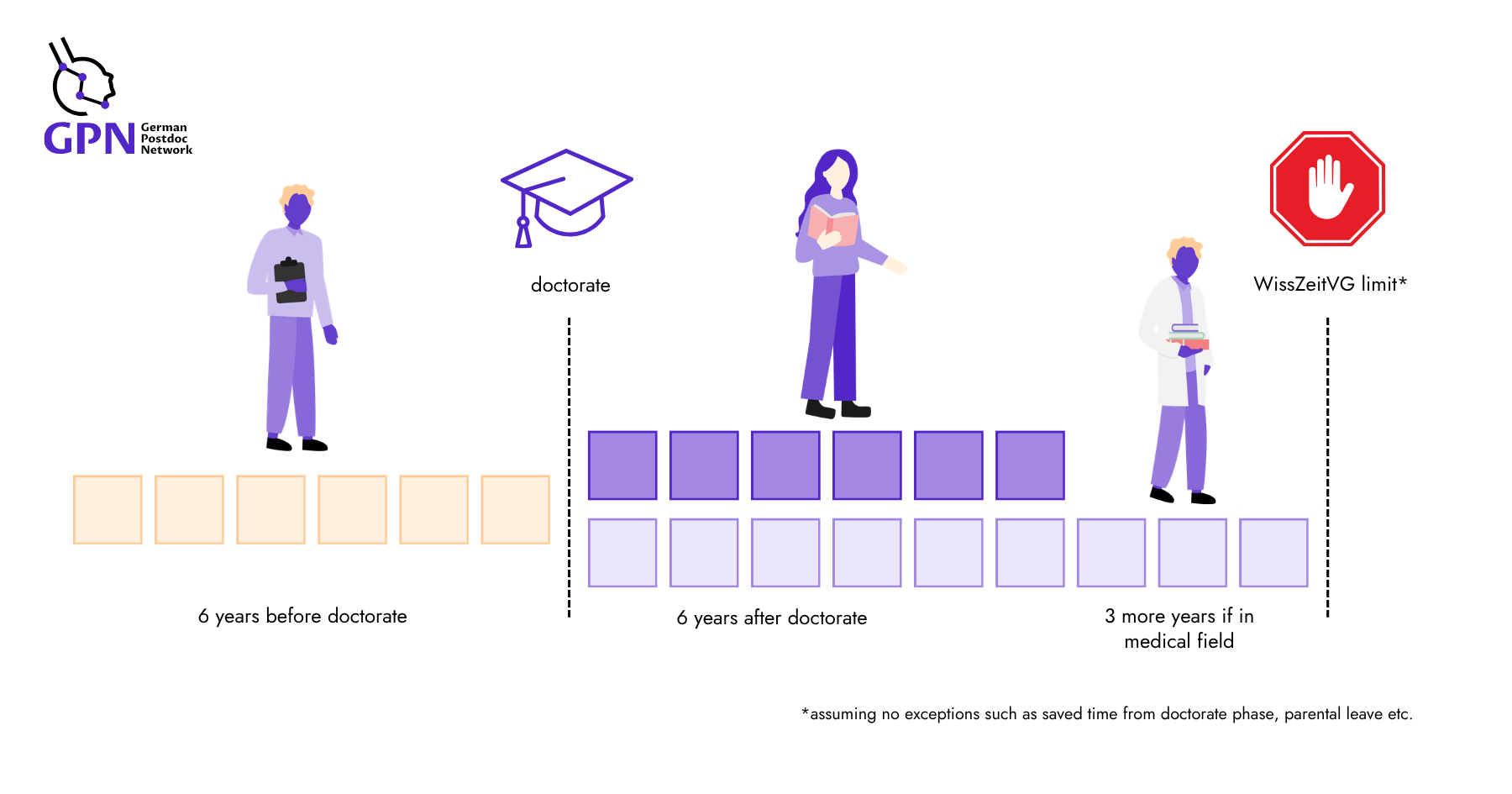
Postdocs in Germany may generally be employed for up to six years on fixed-term contracts after completing their doctorate degree, according to German labour law regulations. For researchers in medicine, the limit is 9 years. Special considerations apply for grant-funded positions; please read further in this FAQ for more details. Importantly, the WissZeitVG is currently being amended by the Federal Ministry of Research, Technology and Space (BMFTR).
Does time spent on a doctorate degree affect postdoc limits?
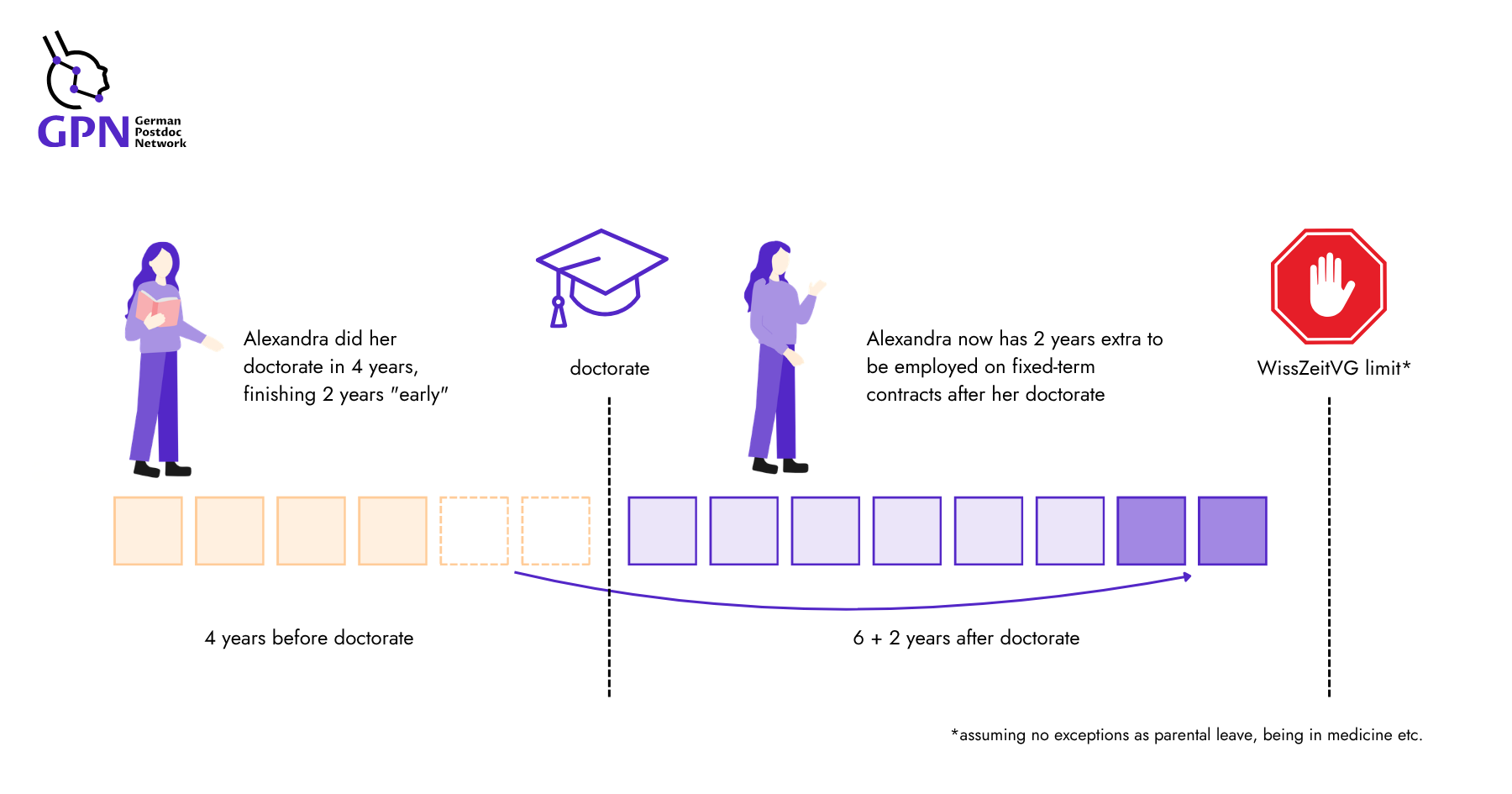
Yes. There exists a “6+6 year rule” which allows up to six years before and six years after the doctorate degree for time-fixed contracts. For postdocs in medicine, the rule is 6+9 years. If the doctorate degree is completed in less than six years, "unused" time can be added to the postdoctoral phase. If your doctoral time took longer than six years, you should consult with your HR department for further advice. For example, a four-year doctorate degree enables two more years as a postdoc (see figure below). This principle of being able to use "saved" time from the doctorate phase in your postdoc phase should apply regardless of whether the doctorate was completed in Germany or not, but the legal text isn't 100% clear. You will need to consult with your HR department for individualised feedback, as there may be specific considerations for your situation. As stated at the top of this document, this is not formal legal advice. Always talk to your HR staff and supervisor about your specific situation before taking action and making plans.
What counts toward the cumulative limit?
All fixed-term contracts with more than 25% of regular working hours at German universities or research institutions count toward the legal limit. Contract periods are counted together, regardless of breaks between jobs or changes in employer. Stipends or scholarship periods and contracts abroad do not count toward WissZeitVG limits. Third-party funded postdoc employment contracts also count toward the total if they are for an academic qualification (but they are also allowed once the time limit is reached). See also "What are the formal qualification objectives" - this is core to defining what a "postdoc" contract is - and the section on "Do all types of postdoc contracts fall under WissZeitVG, e.g. external grant funded contracts?"
Are fellowships or contracts abroad counted towards WissZeitVG time?
No. Only German employment contracts count toward the WissZeitVG time limits. Periods spent on stipends/scholarships or contracts abroad typically do not count toward the 6+6-year allowance. However, it can get unclear in certain situations (working remotely etc), and specific institutions may have further rules in this regard.
One of the consequences of this is that once a postdoc has used up all of their WissZeitVG time, it is often advantageous for the employer to hire a new experienced person - possibly from abroad - compared to making the existing person permanent. For many disciplines, there is a wealth of international talent to draw on for fixed-term contracts if the local pool has "dried up" due to workers maxing out their WissZeitVG time. One possible symptom of this structure is that 74% of respondents in a recent survey of Max Planck Society postdocs were immigrants (Russell et al 2025).
Reference: Russell, N. J., Davies, R. J., Skirgård, H., Wiegand, A. C., & Samwald, S. (2025). The 2024 PostdocNet General Survey. doi:10.17617/2.3658330.
One of the consequences of this is that once a postdoc has used up all of their WissZeitVG time, it is often advantageous for the employer to hire a new experienced person - possibly from abroad - compared to making the existing person permanent. For many disciplines, there is a wealth of international talent to draw on for fixed-term contracts if the local pool has "dried up" due to workers maxing out their WissZeitVG time. One possible symptom of this structure is that 74% of respondents in a recent survey of Max Planck Society postdocs were immigrants (Russell et al 2025).
Reference: Russell, N. J., Davies, R. J., Skirgård, H., Wiegand, A. C., & Samwald, S. (2025). The 2024 PostdocNet General Survey. doi:10.17617/2.3658330.
Do postdocs funded by all types of contracts fall under WissZeitVG, e.g. do external grants count towards WissZeitVG funded contracts?
This can be complicated, and you should seek advice from your HR department to be 100% sure of the facts of your precise situation. Generally, all regular postdoc contracts in Germany will be covered by the WissZeitVG (excluding stipends and scholarships). For example, it does not matter if you are paid from core funding or a third-party source. However, some third-party funded contracts and certain visiting roles may follow separate rules.
Third-party funded research generally counts towards your maximum WissZeitVG-time, but you are also able to be on third-party funded research contracts after you have reached your maximum time. Following, for information purposes is an example of one approach for career planning and while there are many ways to plan your career, some may focus on optimising for having as much time as possible in the postdoc phase. Here, if you have access to funding both from core funding and external grants, it may be technically better for you to not be on third-party funding time until after you have maxed out your WissZeitVG-time. This way, you would be "saving up" the third-party funding time until other "regular" postdoc employment is no longer possible. See the example below with Anna and Richard for illustration. This is an advantageous solution for you personally in order to make the most of your opportunities in terms of time being employed; however, it is probably hard to realise in practice. In addition, securing your own research grant (even before your WissZeitVG time is up) is a way of becoming more attractive on the academic labour market, so this approach may not be advantageous after all. This demonstrates there are multiple factors, important for determining which contract falls under WissZeitVG; see "What are 'qualification objectives'?" above.
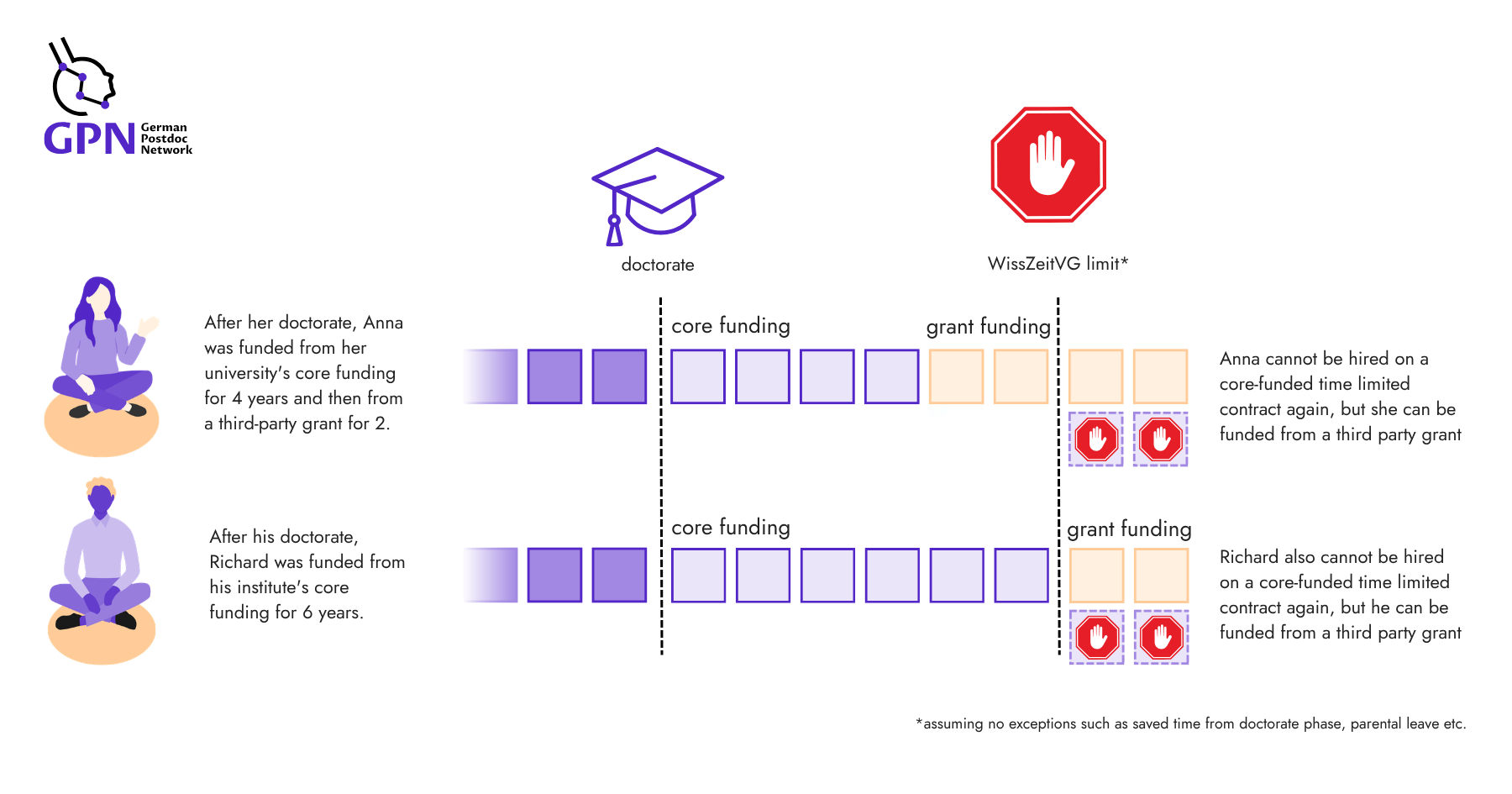
Third-party funded research generally counts towards your maximum WissZeitVG-time, but you are also able to be on third-party funded research contracts after you have reached your maximum time. Following, for information purposes is an example of one approach for career planning and while there are many ways to plan your career, some may focus on optimising for having as much time as possible in the postdoc phase. Here, if you have access to funding both from core funding and external grants, it may be technically better for you to not be on third-party funding time until after you have maxed out your WissZeitVG-time. This way, you would be "saving up" the third-party funding time until other "regular" postdoc employment is no longer possible. See the example below with Anna and Richard for illustration. This is an advantageous solution for you personally in order to make the most of your opportunities in terms of time being employed; however, it is probably hard to realise in practice. In addition, securing your own research grant (even before your WissZeitVG time is up) is a way of becoming more attractive on the academic labour market, so this approach may not be advantageous after all. This demonstrates there are multiple factors, important for determining which contract falls under WissZeitVG; see "What are 'qualification objectives'?" above.
How many individual contracts can a researcher have under WissZeitVG?
There is no strict cap on the number of separate fixed-term contracts a researcher can hold under the WissZeitVG—what matters is the total duration spent in qualifying fixed-term academic employment. Researchers may have multiple consecutive contracts across different institutions or within the same institution, as long as the cumulative period does not exceed six years before and six years after the doctorate degree (or nine years in medicine). For example, a researcher could have several postdoc contracts or a series of project-specific contracts, but the total qualifying time must not surpass the legal maximum. There are however other German labour laws that govern how many short-term contracts you can have with the same employer (see Teilzeit- und Befristungsgesetz (TzBfG) and the Tarifvertrag für den öffentlichen Dienst (TVöD/TV‑L)).
This means the law limits total qualifying time across contracts, not the raw quantity of contracts themselves. Researchers should carefully monitor their accumulated contract periods and clarify details with human resources to avoid unintentional overruns. However, other industrial regulation laws may apply and may be applied differently in different institutions. If this applies to you (e.g., main contract of 50% and continual 50% top-ups), you should discuss your situation with your institution.
This means the law limits total qualifying time across contracts, not the raw quantity of contracts themselves. Researchers should carefully monitor their accumulated contract periods and clarify details with human resources to avoid unintentional overruns. However, other industrial regulation laws may apply and may be applied differently in different institutions. If this applies to you (e.g., main contract of 50% and continual 50% top-ups), you should discuss your situation with your institution.
Leave, childcare, parental leave, extension, etc.
Can postdoc contracts be extended for childcare or family reasons?
Yes. Extensions may be granted for childcare, caring for relatives, or other legitimate reasons. These exceptions are usually applied only to periods of formal employment, not stipends. If you need to take leave for these or other reasons, it is best to check with your Institute's HR department.
Can family, parental, or maternity leave extend WissZeitVG contracts?
Yes. Under WissZeitVG, periods of parental leave, maternity leave, or a significant reduction in working hours (at least 20% reduction) to care for children under 18 can legally extend the maximum permissible contract duration—usually up to two years per child. For maternity protection, contract extension covers the statutory maternity leave period, for example maternity leave or parental leave. These extensions are granted by law if the employee agrees; no new contract is needed, only an official extension.
How is sick leave handled?
Long-term incapacity due to illness, if not covered by paid sick leave rights, can also entitle employees to an extension of their WissZeitVG contract. This covers periods where there is no entitlement to continued pay under relevant legislation or collective agreements. The extension should reflect the actual duration of absence due to illness.
Is sick leave grounds for extension?
Yes. Long-term incapacity due to illness can justify contract extension for the duration of absence if the period is not covered by paid legal or contractual sick leave. Only the time during which neither work nor salary is received counts for extension, and it must be agreed formally with HR.
What about compassionate or care leave?
Significant time off (or substantial reduction in working hours) to care for children or dependent relatives can also extend the maximum contract period, usually by up to two years for care responsibilities. This includes representative roles such as Equal Opportunities Officer or other formal care duties, provided the reduction is at least one fifth (20%) of standard hours. Check with the individual policies at your institution.
What about compassionate leave or care for relatives?
Periods spent caring for relatives in need (e.g., children, dependent parents) or serving as an Equal Opportunities Officer or similar representative can also justify a contract extension—typically up to two years for such caring responsibilities. The leave must reduce regular working time by at least 20%.
Are externally funded contracts treated differently in terms of extensions?
Yes. For externally funded staff, like those on project contracts, statutory extensions for parental leave, etc., may not apply. If the funding agency (like DFG) allows, project contracts might be extended at no extra cost, or else hiring a replacement staff member may be permitted; however, this depends on the funder's rules. You will need to check with HR and the funder’s guidelines.
Are there limits on total extension?
In general, yes. The law sets a cap of two years extension per child, and family or compassionate leave must be significant (at least 20% reduction of regular time). Multiple extensions can be combined up to these legal maximums. Extensions are offered by law, but must be agreed upon with HR and may not require a new contract, only an official adjustment to the end date. Confer with HR for guidance at your institution.
How do I apply for an extension?
Inform HR, provide documentation (e.g., proof of birth, medical certificate, or care confirmation), and request a formal extension. Consent from your employer is necessary, so early consultation with HR is advised, especially for externally funded employees. It will be handled differently at each institution.
What next
What happens when the maximum time is reached?
Once a researcher with a doctoral degree has reached the maximum permissible time on fixed-term contracts under the WissZeitVG (most often 6 years), further fixed-term non-grant employment as a researcher in Germany is generally not allowed. Permanent contracts or employment in academia but outside of the WissZeitVG (e.g., administrative or technical roles) are possible alternatives, but these pathways are not guaranteed. It is also possible to be employed on a fixed-term contract via third-party funding (e.g. DFG Eigene Stelle, European Research grants, and many other funders) - but as individual conditions may vary we advise you to discuss with an HR professional before planning.
Some employers may wish to issue postdoc contracts after the WissZeitVG time, or many short contracts throughout the WissZeitVG time. This could pose a risk to the employer as an employee could argue that the position, in a case like this, is not a temporary position and could formally argue for tenure. As such, career planning should try to avoid this situation.
Some employers may wish to issue postdoc contracts after the WissZeitVG time, or many short contracts throughout the WissZeitVG time. This could pose a risk to the employer as an employee could argue that the position, in a case like this, is not a temporary position and could formally argue for tenure. As such, career planning should try to avoid this situation.
After the postdoc: Tenure tracks and professorships.
Becoming a professor in Germany is generally very competitive. Only a minority of postdocs eventually secure professorships - recent data suggest between 10%-15% obtain a permanent academic professorship in the long run, with the remainder pursuing alternative careers [see references 1, 2, 3]. Success depends on discipline, publication record, external funding, teaching, and sometimes mobility or language skills. Many German professorships are now offered as tenure-track (W1/W2), typically lasting six years, but there are still far fewer of these positions compared to the number of researchers in the postdoc phase. The WissZeitVG normally does not apply during a tenure track process. If you are taking a professorship position after the postdoc, you should read the offer carefully. Many may offer the chance of tenure after successful completion of the first phase of the tenure track process. Ongoing employment will still be at the decision of the institution involved. Care should be taken, as not all professorships lead to a tenured position and the applicant should read the advertisement and contractual conditions carefully for future prospects and expectations.
The number of mid-level permanent research roles and professorship positions in Germany has declined markedly since the 1970s, as evidenced in Leendertz (2020) [4], according to a study of employment conditions at German universities and Max Planck Institutes.
References:
[1] Müller, M. (2025). "From PhD to Professorship: A Practical Guide to Academic Careers in Germany".
[2] Academic Staff | Data on Higher Education in Germany. (2025). [CHE Hochschuldaten].
[3] Buwik untermauert hohe Befristungs-Quoten. (2025). Forschung & Lehre.
[4] Leendertz, A. (2020). Wissenschaftler auf Zeit: Die Durchsetzung der Personalpolitik der Befristung in der Max-Planck-Gesellschaft seit den 1970er-Jahren.
The number of mid-level permanent research roles and professorship positions in Germany has declined markedly since the 1970s, as evidenced in Leendertz (2020) [4], according to a study of employment conditions at German universities and Max Planck Institutes.
References:
[1] Müller, M. (2025). "From PhD to Professorship: A Practical Guide to Academic Careers in Germany".
[2] Academic Staff | Data on Higher Education in Germany. (2025). [CHE Hochschuldaten].
[3] Buwik untermauert hohe Befristungs-Quoten. (2025). Forschung & Lehre.
[4] Leendertz, A. (2020). Wissenschaftler auf Zeit: Die Durchsetzung der Personalpolitik der Befristung in der Max-Planck-Gesellschaft seit den 1970er-Jahren.
Are permanent mid-level academic positions realistic?
Permanent or long term mid-level (non-professorial) roles exist (sometimes called "Akademischer Rat", "Staff Scientist", or "Lecturer"), but are rare and vary by university/institution. Such roles are more common in STEM fields or large research groups. Some stakeholders in policy discussions aim to create more such positions, but competition remains high, and most contracts (outside of professorships) are still fixed-term.
Because non-German experience does not count towards your WissZeitVG-time, once a postdoc has used up their time the employer can be incentivized to hire a new person from abroad instead of offering tenure. Since there are very few permanent positions in Germany, this suggests that the postdoc community in Germany is and will continue to be at least partially characterised by an international and transient community.
Because non-German experience does not count towards your WissZeitVG-time, once a postdoc has used up their time the employer can be incentivized to hire a new person from abroad instead of offering tenure. Since there are very few permanent positions in Germany, this suggests that the postdoc community in Germany is and will continue to be at least partially characterised by an international and transient community.
How about careers outside academic research?
Postdocs can also transition to industry, science management, public policy, or communication roles. Transferable skills—grant writing, project management, data analysis, and team leadership—are often valuable in these sectors. Such employment does not include progression towards academic qualification and therefore does not qualify as a "postdoc" in the sense of the WissZeitVG. For further advice see the GPN Career Path Cards (work in progress).
What support is available for planning career transitions?
Many universities and most major German research organisations (e.g., Max Planck Society, Leibniz Association) offer career counseling for postdocs, including status reviews in later postdoc years. These may include consultations, mentoring programmes, and workshops focused on academic and non-academic options.
Non-EU citizens
What type of visa do postdocs need in Germany?
Postdocs without EU-citizenship usually require a residence permit for research purposes (Section 18d of the Residence Act). This permit is issued based on an employment contract or hosting agreement with a German research institution. For longer stays (more than 90 days), a residence permit and relevant work visa are mandatory (e.g. Blue card or Researcher Permit).
Does a WissZeitVG contract guarantee a visa or residency?
A valid WissZeitVG contract is required for residence permit applications but does not automatically guarantee approval. Researchers must show proof of employment, sufficient funding, health insurance, and accommodation. International postdocs must also register with the city (Anmeldung) and apply for permits promptly upon arrival.
What happens to my residency permit if my WissZeitVG contract ends?
Upon successful completion of research activities, researchers without EU-citizenship may be eligible for an 18-month residence permit to look for work, provided they can support themselves financially during this job search period. This is a possibility, but not a guarantee. During this time, it is possible that they can support themselves with the monthly payments from unemployment insurance. Please talk to an HR professional and/or staff at the foreign office before making plans. If a new contract is secured (permanent or another fixed-term role), a new regular residency permit can be issued.
Can I change research institutions or projects during my stay? (for non-EU citizens)
Changing institutions is possible but requires updating visa documentation and potentially restarting residency permit processes, especially if contracts are interrupted. Ensure new contracts meet qualification and funding criteria under the WissZeitVG to avoid gaps in residency status. Please consult with HR and the immigration office for further detail.
Where can non-EU postdocs find further guidance?
It is important that you speak to your PI/professor/director/supervisor/mentor and HR at your institution to provide specific advice. This is particularly important when taking leave, like family leave, or switching contracts or obtaining additional funding.
What's happening with the law
What recent changes are planned for WissZeitVG?
There have been debates for reforms to the WissZeitVG. Proposed reforms in 2025 include reducing the maximum postdoc contract to four years and introducing minimum contract durations for all phases. Current political parties have differing views on the WissZeitVG and are presented without comment. The GPN will provide updates regarding reforms when additional information becomes available.
What are postdoc organisations saying about the WissZeitVG reform discussions?
- Joint statement from the German Postdoc Network and seven other R2 and R3 researcher networks
- Joint statement in 2026 of the Helmholtz Association PostDoc Network, Max Planck PostdocNet, and Leibniz PostDoc Network - endorsed, among others, by the GPN Working Group Advocacy
- Joint statement in 2024 by Max Planck PostdocNet and many others
- Statement in 2024 by the young High Energy Physics association
- Statement in 2024 by Die Junge Akademie
- Joint statement in 2023 by German Association for Junior Professorship, German Trade Union for Education and Research and many others
Would the WissZeitVG reform affect non-EU postdocs?
Recent changes and reform proposals - such as the possible reduction of postdoc phase durations (from 6 to 4 years) and stricter visa-linked contract requirements - may impact uncertainty for international researchers. The maximum duration for postdoc contracts may become shorter, and this could complicate long-term career and residency planning for non-EU researchers.
I heard about “Ich bin Hanna”. What is it?
The phrase or hashtag "Ich bin Hanna" (#IchbinHanna) originated as a protest and awareness campaign by scientists against the precarious and fixed-term working conditions imposed by the WissZeitVG in Germany. The name "Hanna" comes from a character in a 2018 explanatory video by the German Federal Ministry of Education and Research (BMBF) which portrayed the WissZeitVG's rules in a positive light.
Scientists used "Ich bin Hanna" to share personal stories and highlight issues like temporary contracts, job insecurity, and limited career prospects under WissZeitVG. The hashtag became a symbol for those affected negatively by the law and sparked broad discussion about working conditions in German academia.
In short: "Ich bin Hanna" is a rallying cry among researchers facing precarious academic employment and represents a call for reform of fixed-term contract rules in German science.
Scientists used "Ich bin Hanna" to share personal stories and highlight issues like temporary contracts, job insecurity, and limited career prospects under WissZeitVG. The hashtag became a symbol for those affected negatively by the law and sparked broad discussion about working conditions in German academia.
In short: "Ich bin Hanna" is a rallying cry among researchers facing precarious academic employment and represents a call for reform of fixed-term contract rules in German science.
Authors: Sam Tickell, Hedvig Skirgård
Contributor: Yves Klinger
Visuals: Hedvig Skirgård