Throwback: Fake Papers, Real Damage
We had the pleasure to host freelance journalist Anja Reiter at our recent Understanding the system lunch talk. The session focused on Paper Mills, commercial companies that fabricate or manipulate scientific papers for profit. In her talk, Anja Reiter shared insights from months of investigative reporting for DIE ZEIT. Drawing on conversations with researchers, journal editors, whistleblowers, and publishers, she explained how paper mills operate, why they thrive under today’s publication pressure, and how AI is accelerating both fraud and detection.
What became very clear: Early Career Researchers should take immediate action. Becoming the next generation of reviewers, editors, PIs, and hiring committee members, research integrity starts now. It is important to know that paper mills exploit vulnerable points of the system, e.g. in targeting guest editors for special issues who are less familiar with the usual processes of a journal, and they also try to corrupt the people who decide what gets published. Anja Reiter shared five practical red flags that guide researchers in recognizing fraud and in protecting their integrity:
- Unexpected offers of authorship or publication for money
Legitimate authorship is based on a genuine scientific contribution, and reputable journals never sell authorship positions.
- Invitations to special issues outside your expertise
Receiving invitations to submit so special issues in fields unrelated to your research may indicate poor editorial practices or predatory publishing.
- Promises of guaranteed publication or unusually fast acceptance
No legitimate journal can guarantee publication before peer review has taken place – claims of acceptance within days or promises to bypass the normal review process are strong warning signs that quality standards are not upheld.
- Suspicious papers
Watch out for, e.g., tortured phrases, duplicated images, irrelevant citations, unusual author combinations.
- Transparency
Protect your own work and data in keeping your raw data, documenting your analyses, using your ORCiD and institutional affiliation.
The issue is no longer confined to a niche concern: paper mills have grown into a global shadow industry. In fact, recent studies suggest that fake publications are growing almost ten times faster than legitimate scientific output. When Anja Reiter first began covering the topic, it took her some time to convince her editor that paper mills matter. Today, however, the problem is widely recognized.
Anja Reiter emphasized that often, researchers themselves are the first line of defense, highlighting the work of Elisabeth Bik, Dorothy Bishop, Anna Abalkina, Guillaume Cabanac, and Bernhard Sabel as scientific sleuths. Publishers, too, have shifted their approach. Rather than denying the problem, many have built larger research integrity teams, invest in AI-assisted manuscript screening, image analysis, detection of fake reviewers, citation analysis, and closer collaboration with the research community. Yet the growing use of AI also fuels an arms race. Technology helps but cannot solve the problem on its own.
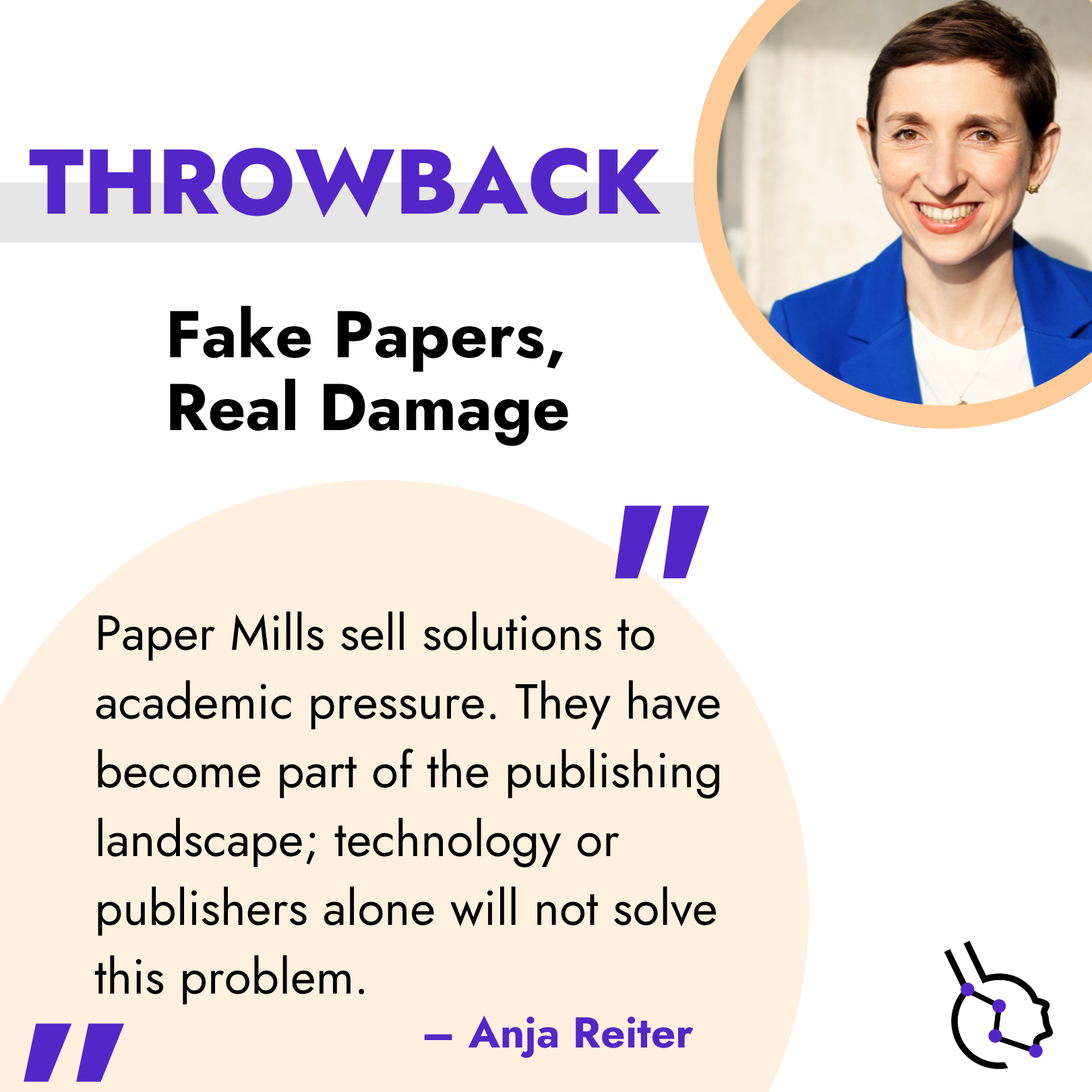
The more conversations Anja Reiter had, the more her own perspective changed: It is not simply a publishing problem, but it affects publishing systems, peer review – and the policies based on the scientific output. Of course, the imminent danger is that fake papers undermine trust in science itself, leading both researchers and the public to question legitimate findings. So, what does it mean for those who play by the rules? Ultimately, protecting the integrity of science is a shared responsibility. While paper mills continue to evolve, maintaining trust in research will depend not only on better detection but also on creating an academic culture that values rigor, transparency, and integrity above publication numbers.
Paper mills are not the root cause but a symptom of a system that too often values quantity over quality. Indeed, paper mills did not invent the infamous “publish or perish” culture but simply found a way to profit from it. Anja Reiter’s lunch talk made clear that combating paper mills is about more than identifying fraudulent publications. Preserving trust in science will require coordinated action across the entire research ecosystem. Researchers need to continue to take peer review seriously, protect their reputation, support their colleagues and remain aware of different publication pressures worldwide. Universities and other research institutions need to reward quality over quantity, strengthen mentoring and integrity training, and recognize the value of both data sharing and negative results. Last but not least, publishers need to continue strengthening their quality control, offer more transparency including timely corrections and retractions, and actively engage in a debate of future publishing models.
Many thanks to everyone who joined the session and shared their questions.