
A Joint Postdoc Statement to the WissZeitVG Reform Draft
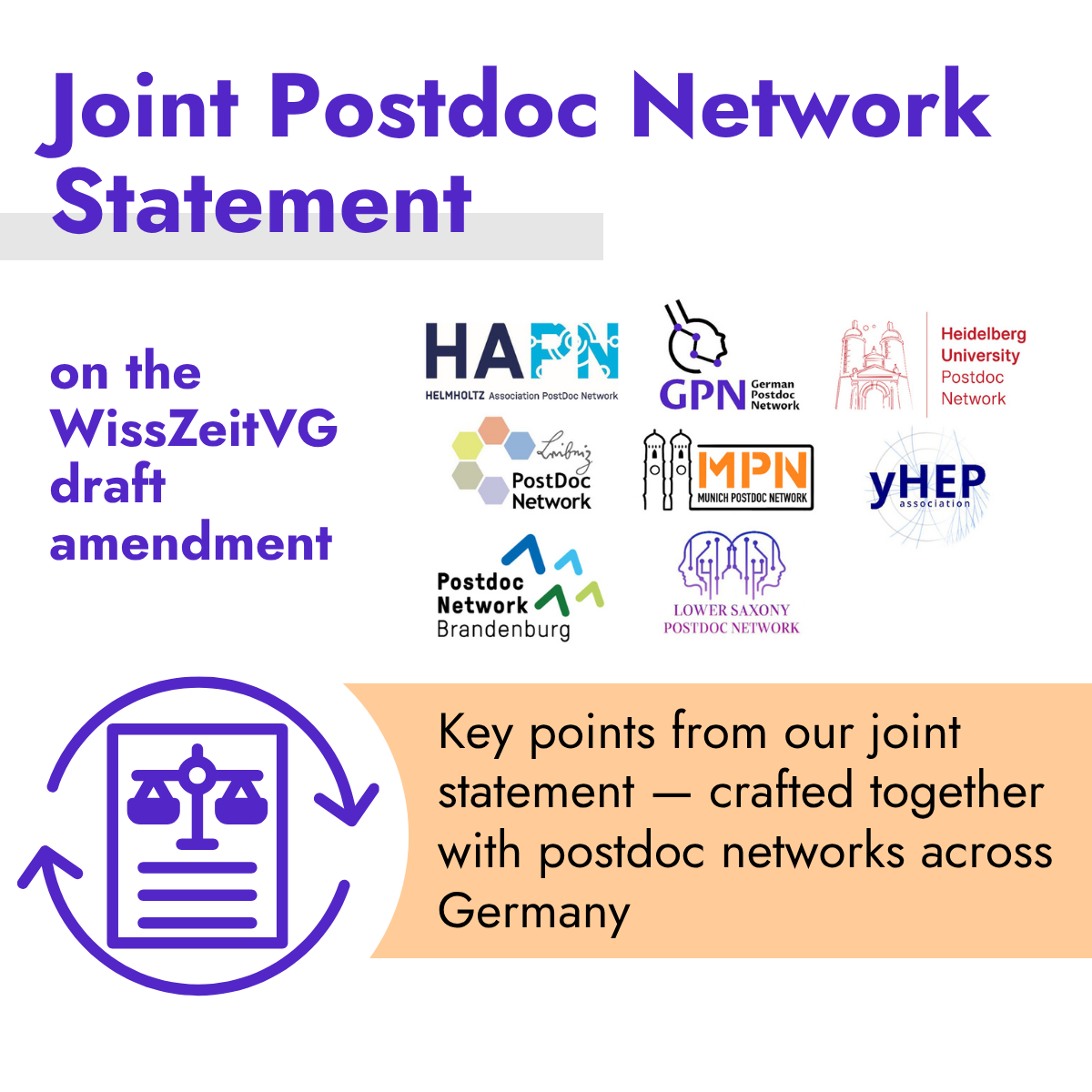
On June 16, 2026, the German Postdoc Network (GPN), alongside seven other R2 and R3 researcher networks across Germany, submitted a joint statement addressing the Federal Ministry of Education and Research’s draft reform of the academic fixed-term contract act (Wissenschaftszeitvertragsgesetz – WissZeitVG). This reform will have major impact on working conditions, career planning security, and the international competitiveness of German Academia. The GPN Working Group Advocacy played an active role in shaping this statement by gathering input from the community, discussing implications of the suggested changes and by ensuring the statement reflects the perspectives and needs of our community.
The collaboration among the signatory networks included the Helmholtz Association PostDoc Network, Leibniz PostDoc Network, Munich Postdoc Network, Heidelberg University Postdoc Network, yHEP, Postdoc Network Brandenburg, and Lower Saxony Postdoc Network. By uniting our voices, we aimed to provide a comprehensive, well-rounded critique of the draft, highlighting both its strengths and the areas where improvement is needed.
What We Welcome
The draft reform introduces several changes that align with long-standing demands from early-career researchers. We particularly welcome:
- Qualification-based fixed-term contracts: The prioritization of qualification-driven contracts (§ 2 Abs. 1) over third-party-funded contracts (§ 2 Abs. 2) is a much-needed shift. It strengthens the purpose of fixed-term contracts as tools for career development. Nonetheless, as we outline below, the practical implementation of this change requires much clearer definitions and safeguards.
- Improved provisions for care, chronic illness, and disability: The expanded regulations for parental leave, caregiving responsibilities, and accommodations for researchers with disabilities or chronic illnesses are essential steps toward a more inclusive and fairer academic environment.
- Minimum contract durations: The proposal to establish minimum contract lengths for first-time employment before and after the PhD is a critical step for planning security. We advocate extending the minimum duration for first postdoc contracts from two to three years to ensure time for meaningful qualification and stability during this critical career phase.
- Mandatory evaluation: The critical evaluation of the reform’s impact is crucial. We urge that this evaluation assess contract durations, qualification practices, career predictability, and long-term perspectives, with a particular focus on unintended consequences, such as the potential lengthening of PhD durations.
Where the Reform Falls Short
While the draft addresses various concerns, it does not go far enough in tackling the structural challenges of academic careers in Germany. Without safeguards, there is a risk that "qualification" could be misused to justify fixed-term contracts without providing opportunities for career advancement. We identified several critical gaps that must be addressed to ensure the reform’s success:
Definition of "Qualification"
The reform’s effectiveness hinges on a precise, actionable definition of what constitutes "qualification" under the WissZeitVG. Currently, the term lacks clarity, risking inconsistent application across institutions and disciplines. Qualification must:
- Be tied to explicit career development goals, such as acquiring scientific, methodological, or leadership competencies.
- Go beyond routine tasks and include structured, justifiable activities aligned with the respective career stage.
- Be documented and verifiable through agreements, development plans, or certifications, with regular progress reviews.
Career Tracks for R3-Level Researchers
The current draft fails to acknowledge the reality of career progression in academia. The six-year limit for qualification-based contracts after the PhD is often insufficient for researchers aiming for professorships or other leadership roles. The addition of an R3-phase would align academic career structures with reality, foster diverse career paths, and incentivize institutions to create more tenure-track opportunities. To bridge the gap, we propose the introduction of a third phase (R3) in the WissZeitVG, characterized by:
- Tenure-track positions with a clear career track, including predefined goals and evaluations.
- Distinct qualification goals for R3, focusing on leadership competencies and high-profile scientific independence.
Carry-Over of Unused Qualification Time
The draft’s proposal to abolish the transfer of unused qualification time from the PhD (R1) to the postdoc (R2) phase aims to make postdoc phases more comparable and, arguably, fairer. However, this change risks inadvertently encouraging longer PhD durations, as researchers may feel pressured to extend their doctoral studies to enter the postdoc phase with a stronger profile.
The Bigger Picture
The WissZeitVG reform can be a step in the right direction, but it cannot stand alone. We call on all stakeholders to view this reform as part of a larger agenda toward valuing early-career researchers as the backbone of the academic system.
Sustainable careers require broader structural changes, including:
- More permanent positions to reduce reliance on fixed-term contracts.
- Transparent, predictable career paths that support transitions from qualification-based roles to stable employment.
- Institutional accountability in implementing qualification agreements, development plans, and tenure-track programs.
We also emphasize the need for flexibility in medicine and psychotherapy, where researchers must complete mandatory clinical training (e.g., Approbation) during their R1 and R2 phases. The reform should align with existing regulations for physicians in training to ensure both clinical and scientific qualifications are accommodated.
Our full joint statement
Read our full joint statement here. For the German version, click here.