
Why Defining the Postdoc Matters, For All of Us
Universities, research organisations, funding agencies, and policymakers all use the term "postdoc"; but rarely do they mean the same thing. This is not a coincidence. In Germany, there is no shared definition of what a postdoc actually is, and that ambiguity shapes the everyday reality of researchers across the country.
At its core, a definition is about belonging. Being recognised as a postdoc should mean belonging to a clearly defined career stage with known career goals and peers on a similar track. It provides the foundation for collective organisation, representation, and institutional support. Without a common understanding of who qualifies as a postdoc, it becomes difficult to establish rights, expectations, and structures tailored to this phase of an academic career.
The consequences extend far beyond individual careers. Because postdocs are not captured as a distinct category in most statistics, even basic questions remain unanswered: How many postdocs are there? How long do they remain in academia? How many move into other sectors, and under what conditions? Without reliable data, any funding programme, career development measure, and policy intervention cannot be meaningfully aligned with the realities of this career stage. Pressure to stand out, the prevalence of temporary contracts, career uncertainty and mobility demands associated with postdoctoral employment therefore remain difficult to quantify, and easy to overlook. Barriers on transitioning to higher career stages become opaque.
A shared definition would therefore do more than provide administrative clarity. It would establish postdocs as a visible and measurable group, creating the foundation for representation, accountability, and evidence-based policy.
As the GPN Advocacy Working Group, we set ourselves the goal of advancing the conversation on the need for a unified definition of the postdoctoral phase. With our proposal, we aim to contribute the postdoctoral perspective and provide a framework for constructive exchange among stakeholders. Our proposed definition integrates multiple conceptual dimensions of the postdoctoral phase, highlighted below and discussed individually in the following section.
- The postdoctoral researcher (postdoc) phase constitutes a transition phaseA following the completion of a PhD[1], during which researchers further develop their skills and independence, broaden their experience, and consolidate their scientific profileB in preparation for future careers in academia or beyondC. Postdoctoral researchers still exhibit key characteristics of R2-levelD,[2] Recognized Researchers.
- Transitioning from R2-level to advanced senior roles (R3) marks the completionE of the postdoc phase, and institutional supportF should aim to achieve this well within the ERC Starting Grant eligibility window (up to 7 yearsG,[3] post-PhD).
[1] A PhD is considered complete upon the successful defense of the thesis.
[2] A not-yet fully independent R2-Recognized Researcher, as in the European Framework for Research Careers.
[3] The 7-year period may be extended due to parental/maternity leave, illness, and other circumstances.
Potential Dimensions of a Unified Definition
A unified definition must balance comprehensiveness with usability, capturing the relevant structural and contextual criteria without sacrificing clear boundaries or practical applicability across disciplines and administrative settings. A key step in this process is agreement on which dimensions should explicitly be included and which remain implicit but still shape practice. This question forms the foundation of any shared definition, regardless of its final form, and serves as an essential starting point for further discussion and future pathways.
| Dimension |
R2 Recognized Researcher |
R3 Established Researcher |
|---|---|---|
|
Research output and independence |
||
|
Publications |
Peer-reviewed articles or comparable publication formats as first or corresponding author. Collaborative contributions as co-author across research groups. |
Consistent publication record as corresponding and senior author, with a growing body of independently led work. |
|
Funding |
Securing smaller grants (travel grants, seed funding, fellowships, or first national projects) or contributing as co-applicant in larger projects. |
Securing significant competitive research funding as principal investigator (e.g., Sachbeihilfe for own position or PhDs, ERC Starting Grant, DFG Emmy Noether). |
|
Professional Independence |
Identifying and defining research questions, developing methodologies to address them, and demonstrating autonomy in managing parts of research projects or leading specific sub-projects. |
Independently leading research projects or significant work packages as a junior research group leader, and developing novel research lines within the broader scope of the institution or discipline. |
|
Conference Presentations |
Regular participation in national and international conferences, presenting work through oral presentations, posters, or first invited talks. |
Regular invited talks at respected conferences or symposia, chairing sessions, and actively contributing to the organisation of conferences. |
|
Teaching and mentoring |
||
|
Teaching |
Limited, dependent teaching responsibilities (guest lectures, tutorials, seminars, lab course supervision). Acquiring first foundational teaching certification. |
Teaching entire courses independently, taking on formal responsibilities such as course coordination or contributing to curriculum development. Developing a teaching philosophy and advanced teaching certifications. |
|
Supervision |
(Co-)supervision of Bachelor’s, Master’s, or PhD students under the guidance of a senior researcher. |
Independent supervision of PhD students and postdocs, with mentees successfully completing their research projects. |
|
Leadership |
Leading small projects, managing tasks within larger teams, or coordinating specific work packages in research consortia. |
Managing mid-sized research projects or research groups, mentoring team members, and shaping team strategy within larger institutional or collaborative frameworks. |
|
Academic service and governance |
||
|
Community Engagement |
Involvement in professional networks, societies, or associations, contributing to workshops, acting as session chair at conferences, or participating in public outreach activities. |
Holding active roles in professional societies (e.g., committee membership), organising events or workshops, and becoming a recognised contributor to the research community. |
|
Academic self-governance |
Participation in departmental and institutional governance activities and contributing to decision-making processes, without formal leadership responsibility. Providing input into academic policies when invited. |
Holding formal roles in institutional governance bodies, with decision-making authority. Taking responsibility for committees, contributing to strategic institutional decisions, and performing representative functions. |
|
Peer Review and Editorial Work |
Reviewing manuscripts for journals and smaller grant proposals. |
Frequently invited to review for high-impact journals and grants, serving on review panels, and taking on early editorial responsibilities (e.g., guest editing special issues and editorial board membership). |
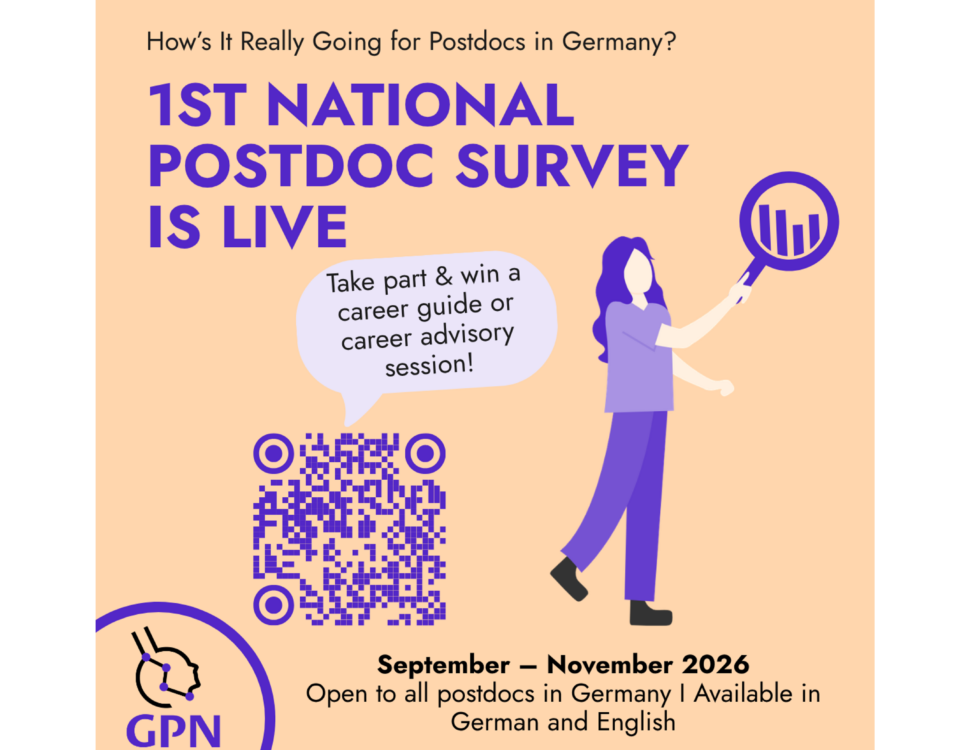
Future Activities: We welcome responses to this post and will incorporate feedback into our ongoing work. Further insights will come from the upcoming GPN survey, which will capture the lived realities of R2&R3 researchers across Germany.
We particularly look forward to the Theme Week organised together with the Volkswagen Foundation (26–28 August in Hanover), where we will co-host the symposium “A Shared Definition of the Postdoc Phase: Analysis, Stakeholders, and Vision for Germany”. The event will bring together postdoc representatives, universities, administrators, funding agencies, and policymakers in a workshop format to discuss pathways towards areas of shared understanding and practical implementations.
Ultimately, it must be acknowledged that any practical definition of the postdoc phase is, by necessity, a starting point. It will not capture every researcher who currently identifies as a postdoc — a label that is often used in the absence of more clearly defined alternatives. Without sharper boundaries separating the postdoctoral researchers from more senior academics, this ambiguity will persist, and with it the difficulty of building coherent identities and appropriate support structures for either group.
Background information
Author: Stefan Pieczonka
Contributors: Martin Blaser, Christophe Bousquet, Nadezda Dolgikh, Maria Dorofeikova, Alexandros Karakostis, Yves Klinger, Jasmin Knopf, Christina Müdsam, Laim Zizmare