

The First German-Wide Postdoc Survey
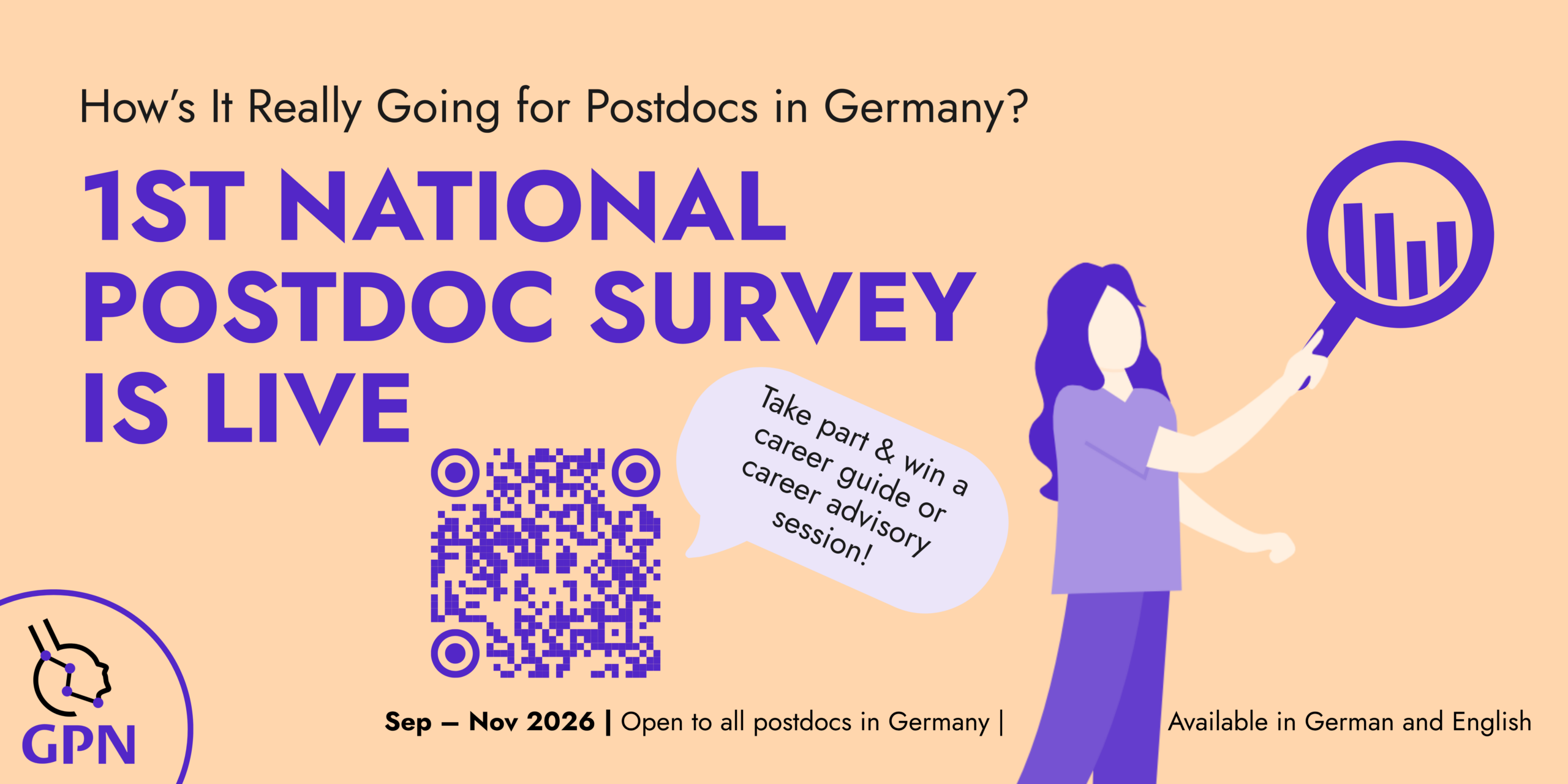
This month, the German Postdoc Network will be starting to collect responses for its first-ever German-wide postdoc survey. In this blog post, we aim to discuss why we are doing it, what our goals are, and how we intend to conduct this ambitious project.
Why are we running a German-Wide Postdoc Survey?
The postdoctoral phase is one of the most precarious, yet one of the most vital stages of the academic ladder. Postdocs conduct a substantial proportion of experimental, analytical, and conceptual research and are central to the scientific output and international competitiveness of universities and non-university research institutions. They go from temporary contract to temporary contract, fighting against the 6-year clock governed by the WissZeitVG, in the hopes of attaining a permanent position inside or outside of academia. Despite this key role, the professional and personal situation of postdocs in Germany remains insufficiently understood at a national level.
One might very reasonably ask: why is collecting data about postdocs important? Why should we even try to understand this phase?
Look no further than the institutional studies, which have been conducted by our colleagues across the postdoctoral landscape in Germany. These institutional surveys have highlighted several recurring issues: limited career predictability, short-term contracts, unequal access to resources, administrative burden, and challenges in work-life balance. The Max Planck PostdocNet surveys (2020, 2022, and 2024) reported concerns regarding employment conditions, career uncertainty, mental health, and equal-opportunity structures, leading to substantial changes in how postdocs are viewed. Similar patterns emerged in the Leibniz Postdoc Surveys (2020, 2022), which identified considerable heterogeneity in support structures and career development prospects, allowing hard and important conversations to be had between postdocs and administration. As well, surveys at universities such as Münster and Jena illustrated high variability in job satisfaction, mentorship quality, and perceptions of institutional support. However, a coordinated, Germany-wide assessment covering postdocs across all institution types, disciplines, and employment arrangements is missing.
There are 4 main points why collecting data is relevant at the German level:
- Political capital: In the current political zeitgeist, there are plenty of people discussing issues that directly affect postdocs, mainly surrounding the WissZeitVG. Surveys by both the Leibniz Postdoc Network and Max Planck PostdocNet have been cited in BMBF papers, recommending certain changes to the WissZeitVG. Therefore, obtaining data from all postdocs across all institutions in Germany allows for more representative and relevant information about this career stage, offering more power when advocating for changes at the state and federal levels. Our results would be shared with institutions such as the BMBF, DFG, and other academic leadership organizations to inform them about issues regarding the WissZeitVG, funding allocations, and local postdoc support structures.
- Accountability: Many German institutions receive public money, and therefore, these organizations and associations must be held to a high standard, making sure that their employees are being treated fairly across the board. However, universities struggle to collect high-quality data and have a harder time using it effectively to make decisions. Therefore, we need to collect the data and make it publicly available to hold universities and political leaders accountable when they make decisions that directly and indirectly affect postdocs.
- Local vs. global: Our survey does not aim to replace the individual institutional surveys that have inspired it. Quite the contrary: our goal is to enhance these individual surveys. A German-wide Postdoc survey will provide a barometer and much-needed context to the institutional surveys, showing how different the results are between postdocs “locally” (institutional) and “globally” (German-wide). Interestingly, we can then compare our German results with worldwide results from surveys such as Nature’s postdoc survey.
- Academic knowledge: Many researchers search for data about career paths in academia and beyond. To give a glimpse into these very challenging professions, everything from mental health to career aspirations is crucial, particularly longitudinal data across years to see trends. As well, the demographic landscape of postdoctoral researchers is extremely diverse, coming from a wide range of educational,
What are we asking about in this survey?
The overarching aim of our survey is to systematically assess the experiences, working conditions, and career trajectories of postdoctoral researchers in Germany. By doing so, we also want to obtain high-quality empirical evidence that can support improvements in postdoctoral working conditions across Germany and inform institutional and national policy recommendations.
Our research objectives for this survey are as follows:
- Characterize current working conditions and overall well-being of postdocs across German institutions, including job satisfaction, workload, mentorship quality, administrative burden, and mental health indicators.
- To evaluate major challenges faced by postdoctoral researchers, including contract conditions, mobility requirements, supervision structures, and access to institutional support.
- To assess career plans and trajectories, including aspirations to remain in academia or transition to non-academic sectors, perceived career prospects, and structural barriers.
- To identify group differences based on relevant sociodemographic and professional factors (e.g., gender, nationality, discipline, parental status, institution type, funding source).
- To establish a longitudinal dataset that allows tracking changes in individual experiences over time, detecting emerging trends, and identifying factors predicting well-being, satisfaction, and academic retention or attrition.
How can you take part?
The survey is currently open and will close by the end of November 2026 - links to the survey can be found below. Participation is voluntary and anonymized. The survey should take about 30 minutes to complete, and all questions will be optional to answer. Participation is completely voluntary and anonymous and cannot be linked back to you, and we will be publishing the results of our survey online following GDPR compliant handling.
As a thank you for participating, you can participate in a raffle for 2 different prizes:
- a book by Mirjam Müller entitled “From PhD to Professorship: A Practical Guide to Academic Careers in Germany” (5 winners), or
- a 60-minute Career Advisory Session with a GSO systemic coach via Zoom.
Survey Links
Author: Nicholas RussellContributors: Maria Dorofeikova, Christophe Bousquet, Christina Müdsam, Maxim Cherkashin, Roman Pauli, Lydia Marie Federmann, Rachel Gilmore, Yves Klinger