The Future of Postdocs in the German Research Ecosystem – Where Do We Stand One Year After the German Council’s Position Paper?
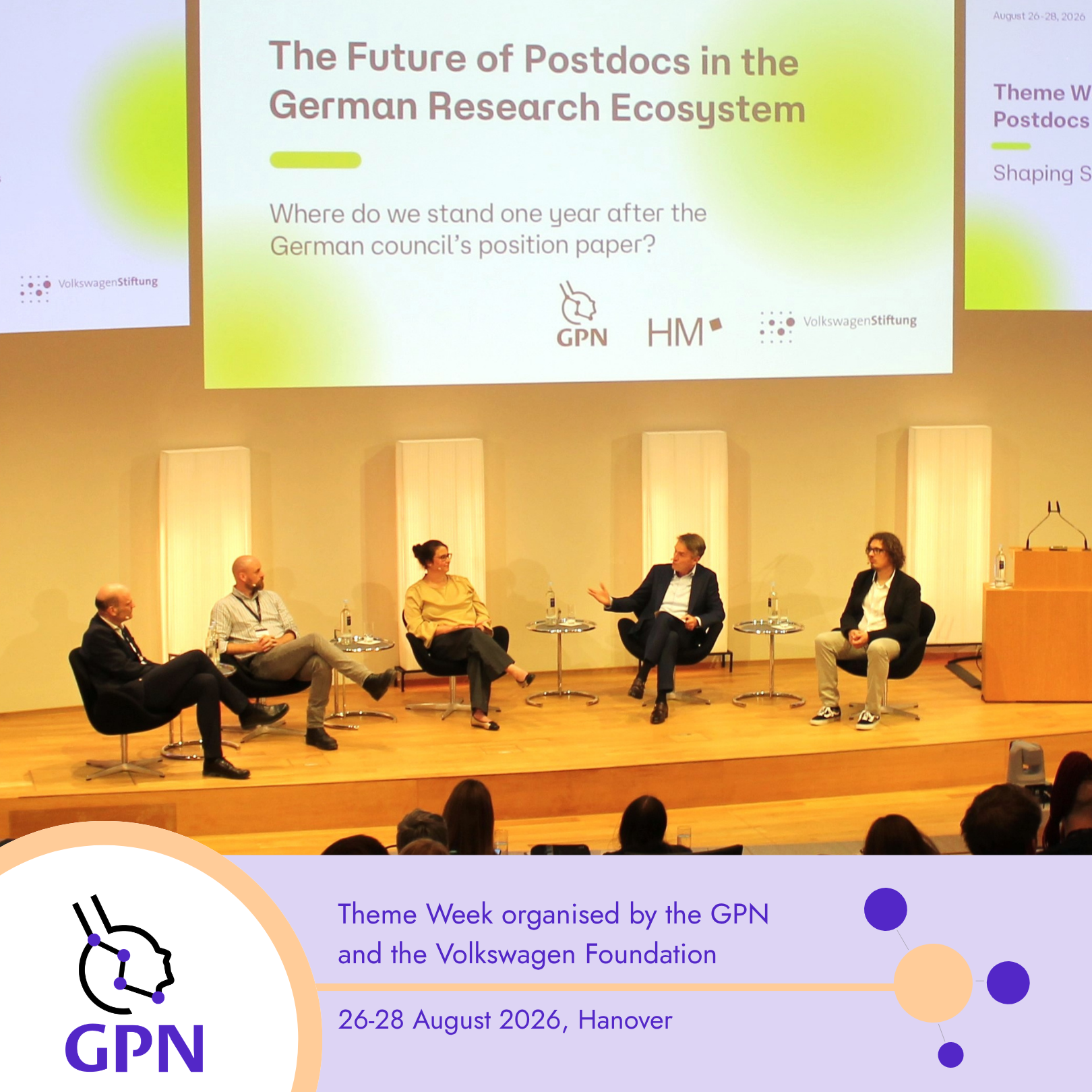
On 26 August 2026, the historic setting of Schloss Herrenhausen in Hanover provided the backdrop for a timely and critical conversation about the future of postdoctoral careers in Germany. As part of the Theme Week “Postdocs and the Research Ecosystem: Shaping Sustainable Career Paths,” organized by the German Postdoc Network (GPN) and the Volkswagen Foundation, we hosted the public panel discussion:
“The Future of Postdocs in the German Research Ecosystem – Where Do We Stand One Year After the German Council’s Position Paper?”
When we developed the concept for our Theme Week, the Science and Humanities Council’s paper on staff structures was a particularly important reference point for us. Few initiatives in recent years have triggered such a strong discussion and generated so much follow-up work. Of course, the discussion about better staff structures did not start with this paper. We are very pleased that some of the key colleagues who have been driving these changes for years have agreed to join us for the Theme Week.
One indication of the paper’s relevance is how often its ideas have since been picked up in discussions and statements – most recently in contributions to the debate around the revision of the WissZeitVG, by networks and organizations across Germany. But there is also something that stands out to us: much of this discussion continues to take place in German. And that means that we risk leaving out precisely those researchers, particularly international researchers, whom we are otherwise trying to attract and retain in the German research system.
So, when we planned this symposium last year, we thought this would be a good moment to pause and look back: What has changed since the paper was published? How has it influenced the discussion? And, perhaps most importantly, what work is still ahead of us? These and further questions were discussed by our panelists:
- Prof. Dr. med. Wolfgang Wick – Chair of the German Science and Humanities Council
- Dr. Linda Jauch – Head of the Hub for Academic Career & Research Culture (HARC), University of Hamburg
- Gareth O’Neill – Principal Consultant on Open Science, Technopolis Group
- Dr. Yves Klinger – Postdoctoral Researcher & Spokesperson of GPN’s Advocacy Working Group
A video recording of the discussion, provided by the Volkswagen Foundation, is available here:
Moderated by science journalist Dr. Jan-Martin Wiarda, the panelists explored where Germany stands today and, importantly, what needs to change to create more transparent, sustainable and diverse career paths for researchers after the PhD.
A few questions and thoughts from the discussion that have stayed with us: What is the ultimate goal of a PhD and the postdoctoral phase? Are we primarily preparing people for academic careers, or should we equally think of postdoctoral careers beyond academia from the start? At the same time, one thing came through clearly: people remain deeply excited about doing research and tackling intellectual challenges. The question is how they can navigate a system that does not always make their options easy to understand. Part of the problem is expectation management and there are things supervisors could start changing tomorrow: For example, how they communicate their perspectives about the research system, support structures, and the conditions under which postdocs work and live. And postdocs themselves have leverage when they organise and advocate collectively, but taking their career planning into their own hands is also part of their responsibility. Jan-Martin Wiarda also couldn’t help but wonder: we have heard many of the points addressed before – so what will we be discussing five years from now? The real test will be what change is actually implemented. Finally, changing structures and academic culture does not necessarily require more money; using the resources that already exist more strategically may be just as important.
The panel was a program highlight open to the public of the first day of our three-day symposium, which brings together stakeholders from academia, research management, funding organisations, industry, and science policy. Across three parallel symposia, participants are working on three closely connected challenges: defining the postdoc phase, developing sustainable personnel structures, and strengthening intersectoral mobility for researchers.
Our aim is not simply to discuss the challenges in the context of the symposia, but to carry these conversations forward beyond the Theme Week.
A big thank you to all panelists, our moderator, the Volkswagen Foundation, and everyone who joined us in Hanover and contributed to the discussion.
Further information about the entire event can be found on our Theme Week 2026 page.
Grant reference number of the Volkswagen Foundation: project no. 0203200-00